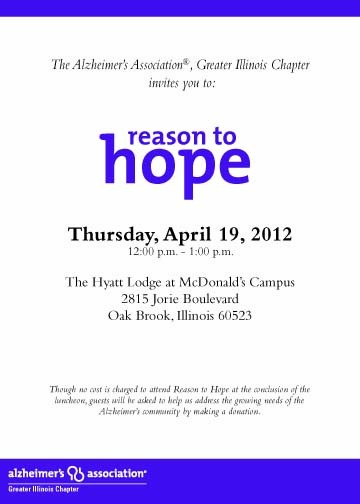
Alzheimer’s Association will be hosting the Inaugural Reason to Hope luncheon in Oak Brook.

On Thursday, April 19, 2012, the Alzheimer’s Association will be hosting our Inaugural Reason to Hope luncheon in Oak Brook. The luncheon will be held at the Hyatt Lodge McDonald’s Campus from Noon – 1 p.m.

Reason to Hope is an important fundraiser for the Greater Illinois Chapter, it gives us an opportunity to educate and inspire people about the valuable services we provide for people with Alzheimer’s disease, their families and caregivers. The luncheon is free; however, all guests invited are asked to make a contribution to the Association at the end of the 60-minute program.

We would be honored if you and your colleagues could attend this powerful program. If you are able to attend the luncheon, please RSVP by Friday, March 30. You can RSVP by phone or email. If you do plan on inviting any guests (we encourage you to do so!), please just forward me along their contact information, so I can add them to our guest list. In addition, please feel free to pass along this email to anyone that is interested in learning more about the fight to end this disease.

To register contact Samuel Provenzano at 847-324-0382 or via email, sam.provenzano@alz.org.

Save The Date 2-3-12 no print marks copy

Zoltan Gaspar, CSA Certified Senior Advisor – Why You Should Work With CSAs?

How do you know you’re dealing with someone who understands the needs of seniors? Here’s what to look for…

When you work with a professional who has added the CSA designation to his or her achievements, you know you’re working with someone who has invested the time and effort in learning about the things that are important to you.

Certified Senior Advisors (CSAs) are the only professionals who have:

  • Met the personal integrity requirements of Society of Certified Senior Advisors’ (SCSA) Disclosure Questionnaire
  • Demonstrated a knowledge of the key health, financial and social issues of the most importance to seniors
  • Agreed to follow the CSA Code of Professional Responsibility, which promotes high ethical business practices

Important: Certified Senior Advisors (CSA) have supplemented their individual professional licenses, credentials and education with knowledge about aging and working with seniors. Know what those licenses, credentials and education signify. The CSA designation alone does not imply expertise in financial, health or social matters.

Are you a Business Professional Who Serves Seniors?

Here’s why anyone who works with seniors needs the CSA designation:

  • CSAs understand how to build effective relationships with seniors because they have a broad-based knowledge of the health, social and financial issues that are important to seniors, and the dynamics of how these factors work together in seniors’ lives.
  • As a CSA, you understand the financial, health, and social issues that seniors face.
  • As a CSA, you know how to communicate more effectively with seniors.
  • As a CSA, you recognize what’s important to seniors and have better relationship building skills – essentials to earning credibility.
  • A CSA understands the surprising complexity of what it means to be a senior today.
  • As a CSA, you gain knowledge and resources to develop an effective marketing plan for the senior market.
Membership Benefits that Make a Difference

Being a member of CSA puts you in an elite group of senior-focused professionals who have a genuine interest in promoting a better life for seniors while growing their own businesses.

The CSA membership benefits include:
  • Resources for Information and Education
    • Senior Spirit Newsletter
    • Professional Journal
    • Expert Webinars
    • Complete Presentations
    • Public CSA Locator
  • Professional Support Tools
    • Content for Your Website
    • Handouts and Guides for Clients
    • CSA Blog
    • Social Media
    • Customized E-Newsletters

The CSA can tailor their benefits to help members and the seniors they serve, in the most meaningful way. Enroll now to be part of an organization that is truly dedicated to its members and provides professional support every step of the way.

ALZConnected connects caregivers, people living with Alzheimer’s

When facing Alzheimer’s disease, it helps to connect with others who relate to your experiences. ALZConnected, powered by the Alzheimer’s Association, is a new online social networking community where people with Alzheimer’s, their caregivers and others affected by the disease can share questions and form new connections.
Join ALZConnected today >>

A Talk with An Elder Driver

In the next 20 years, the population of people age 65 and older is expected to reach 70 million. Many of these will be drivers. In fact, right now, there are about 30 million licensed drivers age 65 or older.

People under age 75 have relatively low crash involvement. However, after age 75, this changes because these drivers may have health conditions or take medications that negatively affect their driving abilities, and this can put them and other road users at risk.

These drivers may not be aware of these changes, or they may not be willing to admit them – to themselves or to others – including family members. Or in the case of people with cognitive impairments like dementia; they don’t necessarily have the insight to recognize poor performance.

Many family members or caregivers wonder what they should do if they think a loved one’s driving skills have diminished. And that’s the dilemma. Family members don’t know how to assess their loved one’s driving abilities. They dread approaching an older loved one to discuss whether he or she needs to modify his or her driving habits or even stop driving.

However, older drivers and their loved ones and caregivers need to take a realistic, ongoing inventory of the older driver’s skills and openly discuss them. Family members need to remember one very important thing: many older drivers look at driving as a form of independence. Bringing up the subject of their driving abilities can make some drivers defensive, angry, hurt, or withdrawn. Be prepared with observations and questions, listen with an open mind, and be prepared to offer possible transportation alternatives.

If you answer “yes” to any of the following questions, you might need to talk about driving with an older driver:

  • Does he or she get lost on routes that should be familiar?
  • Have you noticed new dents, scratches, or other damage to his or her vehicle?
  • Has he or she been warned by a police officer, about poor driving performance, or received a ticket for a driving violation
  • Has he or she experienced a near miss or crash recently?
  • Has his or her doctor advised him or her to limit or stop driving due to a health reason?
  • Is he or she overwhelmed by signs, signals, road markings, and everything else he or she needs to focus on when driving?
  • Does he or she take any medication that might affect his or her capacity to drive safely?
  • Does he or she stop inappropriately and/or drive too slowly, preventing the safe flow of traffic?
  • Does he or she suffer from Alzheimer’s disease, dementia, glaucoma, cataracts, arthritis, Parkinson’s disease,diabetes, or other illnesses that may affect his or her driving skills?

If you answered “yes” to any of the previous questions about an older driver, it is important to have caring, respectful, and non-confrontational conversations about his or her safety, as well as the safety of others on the road. Show genuine concern and understanding, and offer viable alternatives that will not injure the older driver’s self-respect and sense of independence. You might also consider taking a ride with an older driver to observe his or her driving skills, or encourage him or her to get a vision and hearing evaluation, or to enroll in a older driver safety class. You can also discuss your concerns with your loved one’s physician, and ask for recommendations.

The good news is that depending on the severity of the problem, older drivers may be able to adjust their driving habits to increase their safety. For example, they may limit driving to daylight hours and good weather, or avoid highways and high traffic areas.

Information from National Highway Traffic Safety Administration.